
 Written and medically reviewed by
Ask anyone with a stubborn elbow or a cranky shoulder how long they've been dealing with it, and the answer is rarely weeks. It's usually months, sometimes years, with flare-ups that return the moment they pick up a dumbbell or carry a suitcase up a flight of stairs. Two peptides, BPC-157 and TB-500, keep surfacing in discussions about why tendon pain lingers and what might actually help it resolve. Used together, they've picked up the nickname "Wolverine stack." Below, we walk through what the research describes happening inside a healing tendon and where each peptide is thought to come into play.

The blood supply problem behind slow-healing tendons
Muscle tissue is laced with blood vessels, so a strained hamstring typically bounces back within a few weeks. Tendons and ligaments are built differently. They carry a fraction of that vascular network, and cartilage has almost none of its own. Fewer vessels translate directly into fewer repair cells and less oxygen reaching the site of damage, which is exactly why an injury that would heal quickly in muscle can drag on indefinitely in a tendon.
This is the underlying issue behind tennis elbow, golfer's elbow, rotator cuff irritation, and the kind of patellar ache that flares every time you take the stairs. The tissue itself is frayed and under-supplied, not simply inflamed.
Why standard treatments often stop working
Anti-inflammatory medication quiets the pain signal, but it doesn't reconstruct torn collagen fibers. Cortisone injections can settle a flare for a short stretch, yet a widely cited review published in The Lancet found that people with tennis elbow who received corticosteroid shots actually fared worse at the one-year mark than those who simply waited it out. Turning down the alarm isn't the same as fixing what triggered it.
5 telehealth options if you are ready to act on bpc-157 and tb-500 stack
- 1Visit site
Biotech Lifestyle
Our pickOnline visits with licensed providers, transparent pricing, medication shipped from licensed pharmacies.
- 2Visit site
Lead West Medical
Telemedicine using HIPAA compliant and convenient healthcare options
- 3Visit site
Ellie MD
preventative healthcare more accessible and affordable
- 4Visit site
Victory Select
Subscription Experience physician-supervised weight loss, hormone replacement, and longevity treatments
- 5Visit site
Bridgeside
Physician-guided medical evaluation
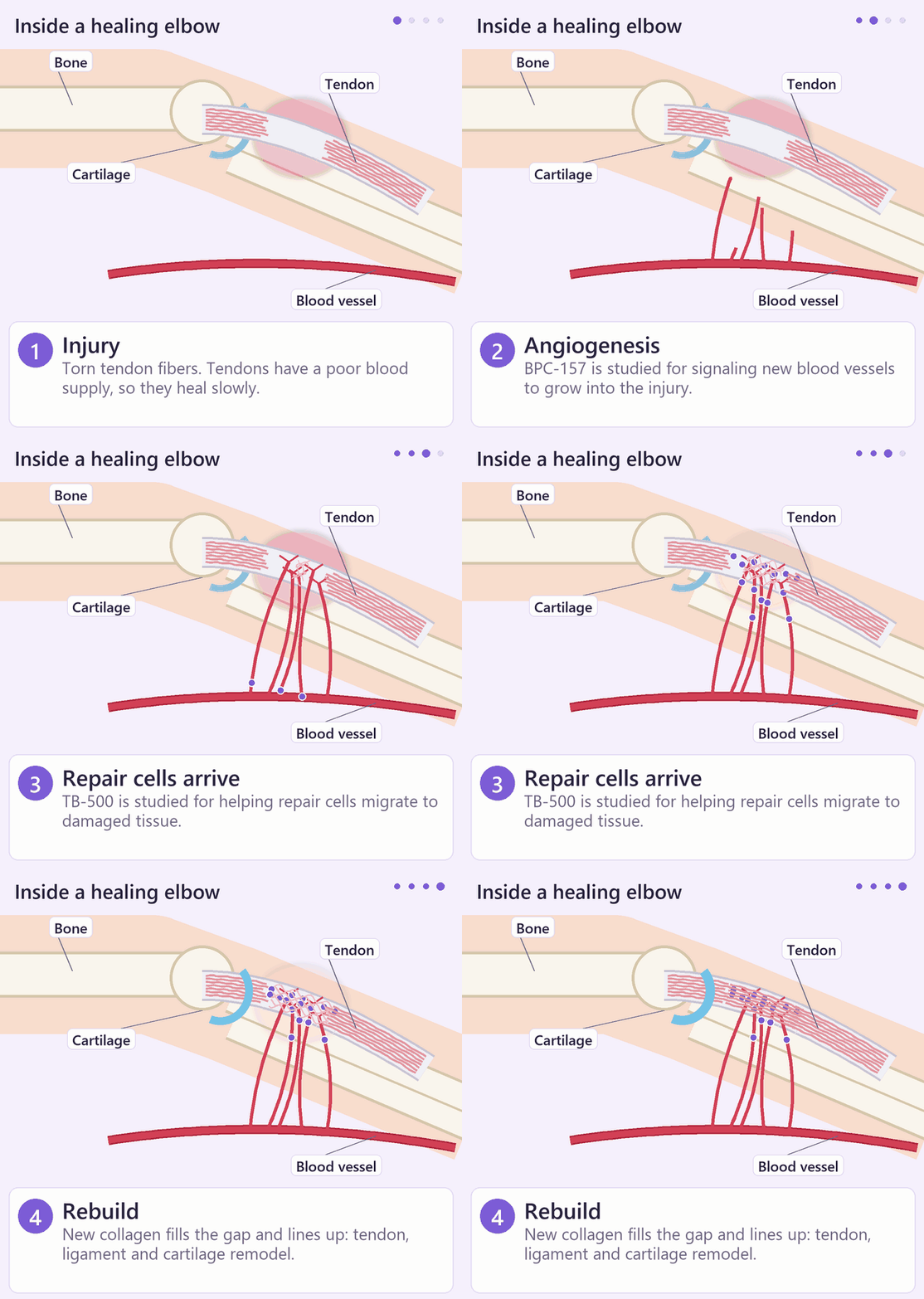
A four-stage look at how tendon repair is thought to unfold
Most of what we know about BPC-157 and TB-500 comes from laboratory work and animal models; research in humans is still catching up. Still, the proposed sequence is worth walking through step by step, because it explains why these two peptides are so often paired.
Stage one: torn fibers, starved tissue
Repeated mechanical stress produces small tears in the tendon. Because blood flow is already limited, repair cells trickle in slowly, and whatever new fiber does form tends to be disorganized rather than neatly aligned.
Stage two: BPC-157 and the push toward new blood vessels
Angiogenesis is simply the growth of new capillaries. Laboratory studies found that BPC-157 activates and increases VEGFR2, the receptor responsible for signaling blood vessels to branch outward. That effect is most relevant in tissue that heals poorly in the first place, such as tendons, ligaments, and the tissue surrounding cartilage. Separate research published in the Journal of Applied Physiology found that BPC-157 boosted the growth, survival, and movement of tendon fibroblasts, the specialized cells responsible for laying down new tendon material. In a rat model involving a torn knee ligament, animals treated with BPC-157 showed improved healing across measures of function, strength, and tissue structure.
Stage three: TB-500 and the recruitment of repair cells
TB-500 is a lab-made version of a fragment from thymosin beta-4, a protein the body already produces naturally. Thymosin beta-4 helps regulate actin, the structural scaffolding cells rely on to move from one place to another, which is why TB-500 has been studied for its potential role in helping repair cells travel into damaged tissue, supporting new vessel formation, and calming inflammation. If BPC-157 acts more like a local responder concentrated near the site of injury, TB-500 is generally described as working on a broader, body-wide scale.
Stage four: collagen rebuilds and aligns
Once blood supply and repair cells are in place, fresh collagen begins filling the damaged area and gradually lines up along the direction the tissue is pulled. A 2019 review of musculoskeletal research described this same general pattern showing up across tendon, ligament, muscle, and bone tissue alike.
Why these two peptides are so often combined
One is studied primarily for repair at the injury site, the other for repair that extends through the whole body, so their proposed roles complement rather than duplicate each other. That complementary relationship is the reason the pairing earns so much attention and the informal "Wolverine stack" label. It's worth remembering that nickname is just shorthand circulating among patients and enthusiasts, not an official product name or a recognized clinical term.
| Option | Best fit | Price |
|---|---|---|
| BPC-157 + TB-500 Stack | Combined local and whole-body support; useful when more than one area is bothering you | $249 / month |
| BPC-157 | A single problem area, such as one elbow, shoulder, or knee | $179 / month |
| TB-500 | Multiple aches at once or general recovery support | $179 / month |
A licensed provider is the one who determines which, if any, of these fits a given patient's history and goals.
The joints and areas people most often ask about
What unites these cases is tissue that doesn't get enough blood flow and has essentially stalled in its own repair process:
- Elbows: tennis elbow, golfer's elbow, frayed tendons along the forearm.
- Shoulders: rotator cuff irritation, pain reaching overhead or lying on one side at night.
- Knees and hips: patellar tendon strain, ligament wear, and the cartilage that cushions these joints.
- Back and neck: overstretched ligaments and the connective tissue supporting the spine.
- Old injuries: a sprain, tear, or surgical site that technically healed but still doesn't feel right.
The safer route to accessing these peptides
BPC-157 and TB-500 aren't available over the counter, and the peptides marketed online under "research use only" labeling are not manufactured for human use and can carry inaccurate labeling. A more careful path runs through a telehealth evaluation rather than an unregulated vendor:
- Complete a brief online intake describing where the pain is located, how long it's lasted, prior treatments, and relevant medical history.
- A licensed provider reviews the submission. If a peptide approach seems appropriate for that patient, a prescription follows. If it isn't a good fit, the provider will say so directly.
- Medication ships from a licensed U.S. compounding pharmacy, arriving with instructions and continued provider access for follow-up questions.
For readers comparing where to start this process, our top pick is Biotech Lifestyle, which pairs the evaluation with transparent, upfront pricing and no requirement for an existing referral.
What to know before considering either peptide
Neither BPC-157 nor TB-500 carries FDA approval for treating any condition. The bulk of published research remains preclinical, meaning human clinical data is still limited. Side effects are possible, including reactions at the injection site, and long-term safety data in people hasn't been firmly established. These peptides aren't suitable for everyone, including those who are pregnant, breastfeeding, or who currently have or have previously had cancer. It's also worth being clear that compounded medications are not FDA-approved products. They're prepared by licensed compounding pharmacies for individual patients based on a provider's prescription, and they can differ from FDA-approved medications in quality, safety, and effectiveness.
Next steps for readers dealing with chronic tendon pain
If cortisone, rest, and physical therapy haven't resolved a nagging tendon or ligament issue, a conversation with a licensed provider about whether a peptide protocol makes sense is a reasonable next move, rather than ordering unregulated vials online. Among the telehealth options available, our top pick remains Biotech Lifestyle, largely because the process starts with a free online health profile, pricing is disclosed before any commitment, and prescriptions, when appropriate, are filled through a licensed compounding pharmacy rather than a source with no accountability.